
We visited the Land of the Rising Sun for New Years 2017 → 2018. We were in Tokyo for a few days in mid-December, and then again for NYE. While coming back from Tokyo to San Francisco on Jan 1, we time traveled, so we started 2018 with a 41 hour day. This was our first time visiting Japan, and we absolutely loved it. We had a lot of memorable experiences, but the highlight was experiencing a unique combination of cutting edge technology and a rich, traditional culture that has evolved over millennia.
Hospitality and Culture
Human beings everywhere are the same, but culture can be very different. I found that the Japanese people on average were extremely respectful. Tokyo is a mega city with high population density in a country where civilization has existed for thousands of years. This usually means no one cares about anyone else and no one has time for anything. Not in Tokyo.
The service at the hotels we stayed at was just amazing, but the hospitality was different than what you find in a hotel in New York or San Francisco. American big city hotels will try to please you but there’s always an upsell or tipping angle to it. We didn’t get that vibe from Japanese hotels and restaurants at all. First of all there’s no tipping culture in Japan. In Tokyo downtown hotels, they just include a service fee. And second, they were ok saying no to a request if it didn’t fit in their rules. If they don’t do take out, they just don’t. It’s not about pleasing you, it’s about being respectful. We were having some problem validating a train ticket, so one of the hotel staff came with us to the station, spoke with the train staff, spent a lot of time going up and down the station floors, figured out the issue and resolved it for me. At no point did she act like she was doing us a favor or express even slight frustration. I felt forever indebted to her. In another instance, the concierge came running half a block behind us to tell us something he had forgotten to mention when we were at his desk. If a staff escorted you to the elevators, they would stand there till the elevator doors closed. In yet another instance, at another hotel with another concierge – I asked her for her pen to write down the names of a few restaurants she was suggesting. She gave me her pen but was extremely apologetic about me having to use a cheap plastic pen because that wasn’t the best pen they had. She got another pen and insisted that I used that one.
And it wasn’t just hotels – they are in the hospitality business after all. Everywhere, they would take and give back my credit card with *both hands* with a slight bow. Even I started doing that in a few days :). Once I called a local sushi place, and the person who picked up didn’t speak English. They replied in Japanese, seemed like they were trying to apologize for not speaking english. I tried breaking it down, simplifying, just used the simplest words. They didn’t understand, but every time they replied very politely in their language. They absolutely didn’t hang up. I had called, so I was supposed to hang up. In San Francisco they would have either hung up or put me on hold in under 3 sec. But even the slightest disrespect didn’t seem like an option here.
People on the streets, trains, stations, even in malls were very disciplined about lines, where to stand, which side of the walkway/escalator to walk, etc. Everything, including the streets (even Takeshita street!) was extremely clean, and there was zero noise. It’s impolite to talk on the phone on public transport in Tokyo – you are supposed to go to the exit area if you absolutely have to talk.
What makes it even more interesting is the juxtaposition of this highly socially sensitive and traditional culture with cutting edge technology. I had only heard of Japanese toilets and never really understood what all the fuss was about. I had to see it to believe it. Their toilet innovation game is on point. They have a museum for Toto toilets in Japan, so I’m not exaggerating. Their local trains were also great – clean, air conditioned, free wifi and on time. You might have heard, just last year one train departed 25 sec earlier so the train company apologized for this ‘inexcusable’ mistake. And then there was Bitcoin already being used as if it existed for years. Even the cribs in the hotel rooms were much better than cribs you find in American hotels or even other countries – much more functional, and yet better looking.
The only one negative for us was smoking – by default, it’s ok to smoke in hotel rooms, restaurants, etc. I’m ok with that but since we were with the baby, we had to take special care. We confirmed with each hotel that the room we were getting was non-smoking. In one of the hotels, they gave us a non-smoking room, but on a smoking floor. So you really have to bend over backwards to stay away from the smell of cigarettes. We would have loved to go to an Izakaya, but we just avoided them altogether because once working hours end, Izakayas start filling up with smoke.
Narita Airport
We flew ANA (All Nippon Airways) from SFO to Tokyo Narita airport. The flight was good – it’s not a fancy airline, but the staff is competent and nice, the food was good and we had no problems with delays or luggage. The Haneda airport is closer to city center, but the ANA flights that go there are usually operated by United. So we picked Narita. Narita airport is big and nice with a lot of great services – luggage storage, luggage transportation to hotels, lot of buses and trains connecting to different parts of Tokyo downtown, kids play areas, and so on.
The Narita Express (NEX) is a train from the airport that runs at a pretty good frequency and gets you to the heart of the city in 50-60 mins. It’s a comfortable train (which was great while traveling with the baby) – it has air conditioning, free wifi and lots of space for luggage. We took NEX both ways.
There are also convenient buses to/from the airport. Right at the outskirts of main Tokyo, there’s a major hub for buses connecting to the airport called “Tokyo City Air Terminal”, popularly known as T-CAT. You can take a bus to T-CAT from the airport and then take a cab to your hotel in Tokyo. The info and ticket counters for all the different transit options from the airport are all next to each other, so we just asked around and picked the option that suited us.
Tokyo Station and Marunouchi
Tokyo station is the railway station with the most number of trains per day in Japan. It’s a massive station with multiple levels of shopping and restaurants underground (they call it “Tokyo Station City”). The main entrance is in the Marunouchi district, which is a proper downtown district with the country’s three largest banks headquartered there. Marunouchi and surrounding areas are quite upscale. Looking around, you won’t find a lot of street food – just a bunch of high rises. These high rises have basements though, which have a ton of shops and restaurants, both small and large – Izakayas, Ramen shops, Sushi restaurants, etc.
We stayed at the Tokyo Station Hotel which is built right on top of Tokyo Station and has heritage property status. It’s a beautiful hotel with amazing service. It closed in 2006 for preservation and restoration and had a re-opening in 2012 – so even though it’s heritage, it’s like new! We were traveling with a 10 month old and they provided us a with a baby stroller to walk around in the area. Loved the food there – because of the baby, we choose hotels with good restaurants because we end up getting room service at least once. In fact, the Wagyu and salmon we had there were some of the best we’ve ever had.
Right across the street from Tokyo Station Hotel is Kitte, an upscale 7-storied mall with a lot of great restaurants on the street and basement levels. A block away, there’s the beautiful Marunouchi Brick Square. There’s an Ippudo Ramen in that square – It was a bit hard to find because it’s a level below ground. Another block away is Bic Camera, a giant department store with tons of electronics, toys, etc. They were already officially and proudly accepting Bitcoin. A block east/south of Bic Camera is Ginza district, another fabulous district for food and shopping.
[Best_Wordpress_Gallery id=”28″ gal_title=”tokyo”]
The Yamanote Line and Shibuya Day Trip
The JR Yamanote Line is a railway loop line around the heart of Tokyo. It connects most of Tokyo’s major urban centers (and also tourist attractions) – Marunouchi (Tokyo Station), Ginza, Shinagawa, Shibuya, Harajuku, Shinjuku, Akihabara. We did a Shibuya day trip using the Yamanote line:
- Shibuya Crossing (Shibuya station) – Popular as one of the busiest pedestrian crossing in Tokyo.
- Takeshita Street (Harajuku Station) – Known for cosplay meetups, Japanese crepes, shopping
- Meiji Jingu and Yoyogi Park (Harajuku Station) – It’s a beautiful park with a massive green area and a magnificent shrine.
[Best_Wordpress_Gallery id=”21″ gal_title=”tokyo”]
Tokyo Bay
For the new years eve phase of our trip, we stayed in the Tokyo Bay area. I specifically chose the Bay view room at the Intercontinental Tokyo Bay not only because it has spectacular Tokyo Bay views, but also because it faces East. I wanted to see the first light of the new year from my room 🙂
[Best_Wordpress_Gallery id=”26″ gal_title=”tokyo”]
During this trip, we went to the Tsukiji Market. The fish market itself is closed for a few days around new years, but there are plenty of food places in the market complex. We ate at Sushizanmai. The good thing about going this time of the year was that the lines weren’t too long. We had to wait only for around 15 mins at Zanmai (I’ve heard the line at this place is 2 hours during peak seasons). Loved the Unagi Nigiri.
We also went to Roppongi hills tower. It’s the tallest building in Tokyo and has a lot of things that make it worth visiting – an observation deck, Mori art museum, dining and shopping, etc. The whole area was beautifully lit for NYE. A quick visit to the observation deck was fun. We absolutely loved the exhibition at the Mori museum – Leandro Erlich’s “Seeing and Believing” (the theme was illusions).
[Best_Wordpress_Gallery id=”27″ gal_title=”tokyo”]
New Years Eve TV Show
NHK Kōhaku Uta Gassen (or simply Kōhaku) *used to be* the most popular TV show that families would watch on NYE. But that’s no longer the case! The new hotness is “Kodoku no Gurume” (“Solitary Gourmet”) which is a tv drama about a traveling salesman who eats alone in small restaurants in different parts of Japan. Sounds like a reality show, but it’s not.
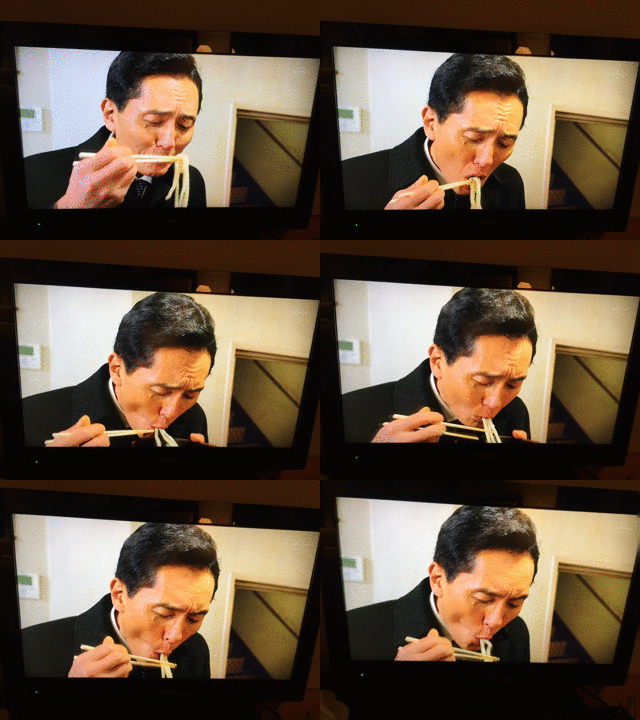 In an episode, there are multiple, really lengthy (~15 min) scenes of the protagonist thoroughly enjoying his food while having an internal monologue about how delicious the food is. I watched the NYE episodes – and I loved it 😀 So much better than the singing reality show (which was running on another channel). Both, food and music have the power of breaking through language and cultural barriers, but the singing show is more about celebrities competing in a reality show, so you need more cultural context. The food show, even though it has monologues/dialogues, is much easier to follow and like.
New Years Day Morning
From Wikipedia at the time of writing:
Hatsumōde (初詣 hatsumōde) is the first Shinto shrine visit of the Japanese New Year. Some people visit a Buddhist temple instead. Many visit on the first, second, or third day of the year as most are off work on those days. Generally, wishes for the new year are made, new omamori (charms or amulets) are bought, and the old ones are returned to the shrine so they can be burned. There are often long lines at major shrines throughout Japan.
We went to Zōjō-ji temple, which is a Buddhist temple in the Minato area. We chose this temple mainly because it was very close to our hotel in Tokyo Bay. The atmosphere there was great – food stalls lined up along the entrance to the temple and lots of people visiting for Hatsumōde.
[Best_Wordpress_Gallery id=”29″ gal_title=”tokyo”]
Things we didn’t do/What we would go for next time
Next time, we’d definitely go in another season – The cherry blossom season is of course very famous and Fall is also very beautiful. Also, since we already experienced the mega city, we would like to go to Kyoto.
Few places in/close to Tokyo where we wanted to go but couldn’t were Akihabara, Ghibli Museum, Uneo Park and Mt Fuji. Akihabara, the “Electric Town” is actually very close to Tokyo Station (next stop), but it was relatively lower on our priority list and we ran out of time. Ghibli Museum is in Tokyo, but not in the heart of the city – So it takes a while to get there and might involve changing trains. Also, from the photos it didn’t seem infant friendly and it seemed a bit too small overall. I wasn’t sure if the long trip would be worth it. So we skipped it (and yes, I’m a big Miyazaki fan). Uneo Park has great fall colors, but we went in the second half of December, so decided to skip. Mt Fuji is actually quite far from Tokyo and seems kinda remote. This was our baby’s first international trip so we didn’t even plan on visiting Mt Fuji.
Another thing we didn’t do was go to fancy restaurants. They are not baby friendly. Also, you have to book way in advance.

 Chinmay Barve
Leave a comment